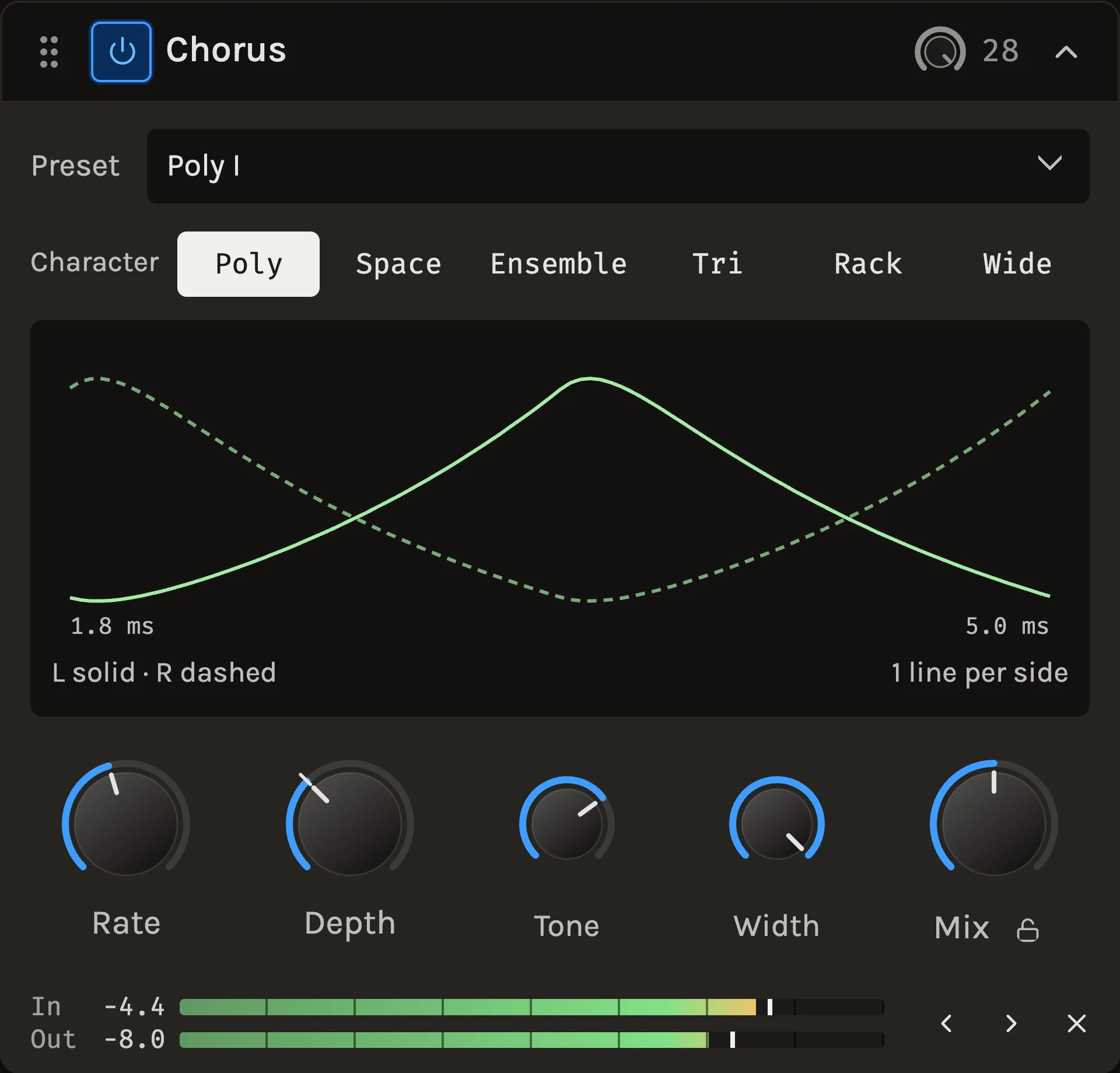
The Chorus thickens a sound with slowly detuned copies of itself. Each of its six characters is a different circuit read from a classic design, with its own number of delay lines, sweep shape and stereo layout, so switching characters changes the kind of movement rather than just its speed. The plot shows the delay sweep over one cycle for both channels.
When to use it
Use it on pads, keys and clean guitar for width and shimmer, on a mono synth line to put it in stereo, or on strings for the shimmering ensemble sound. The presets pair a character with its classic settings: Poly I and II, Poly swirl, Space 2 and 4, Strings, Three-way, Rack and Wide pad. For rhythmic repeats rather than movement, use the Delay.
Controls
Character
Poly is the polysynth chorus: two short lines swept in opposite directions, with a wobble you can hear. Space drives two lines with a slow rounded trapezoid and cross-feeds them for width with little audible motion. Ensemble sweeps three lines 120° apart with a second, faster vibrato on top, as in the string machines. Tri pans three longer lines left, centre and right at rates that never line up. Rack is the clean digital rack chorus, one sine-swept line per side. Wide stacks four lines per side at unrelated rates for a many-voice chorus that masks any single sweep. Switching keeps the lines and the sweep position.
Rate
The sweep speed, 0.05 to 10 Hz. Slow rates under 1 Hz are the classic pad settings; fast rates around 6 to 10 Hz with a small Depth become vibrato or the polysynth swirl.
Depth
How far the lines sweep. 100% is the circuit’s own range; up to 300% exaggerates it. In Ensemble and Poly the sweep is in octaves of delay, so a deep setting also bends pitch further.
Tone
A low-pass in front of the lines, 2 to 20 kHz, the filter the hardware put before its chip. Lower it to keep a bright source from fizzing; Rack leaves it open.
Width
How differently the right channel is swept from the left, from mono movement at 0% to the full antiphase or quarter-cycle offset at 100%. In Tri it also spreads the pans.
Mix
Equal-power blend; 50% is the classic through-the-chorus balance, and 100% gives only the swept copies. Zero is exactly the dry sound.
Tips
- If a chorus pulses in time with itself, change the character rather than the rate: Poly and Rack have one visible sweep, Ensemble, Tri and Wide hide the period.
- For a mono source that should sit in stereo without obvious movement, use Space with Rate around 0.3 Hz and Width at 100%.
- Follow a chorus with a reverb, not the other way round: movement before a space sounds like a room, after it sounds like the room is moving.
All control ranges 5 controls
| Control | Range |
|---|---|
| Rate | 0.05 to 10 Hz |
| Depth | 0 to 300% |
| Tone | 2000 to 20000 Hz |
| Width | 0 to 100% |
| Mix | 0 to 100% |
Keep shaping your sound.
There’s a whole rack to explore.