Meter
Peaks, RMS and loudness in LUFS at any point in the chain, without touching the sound.
Open the studio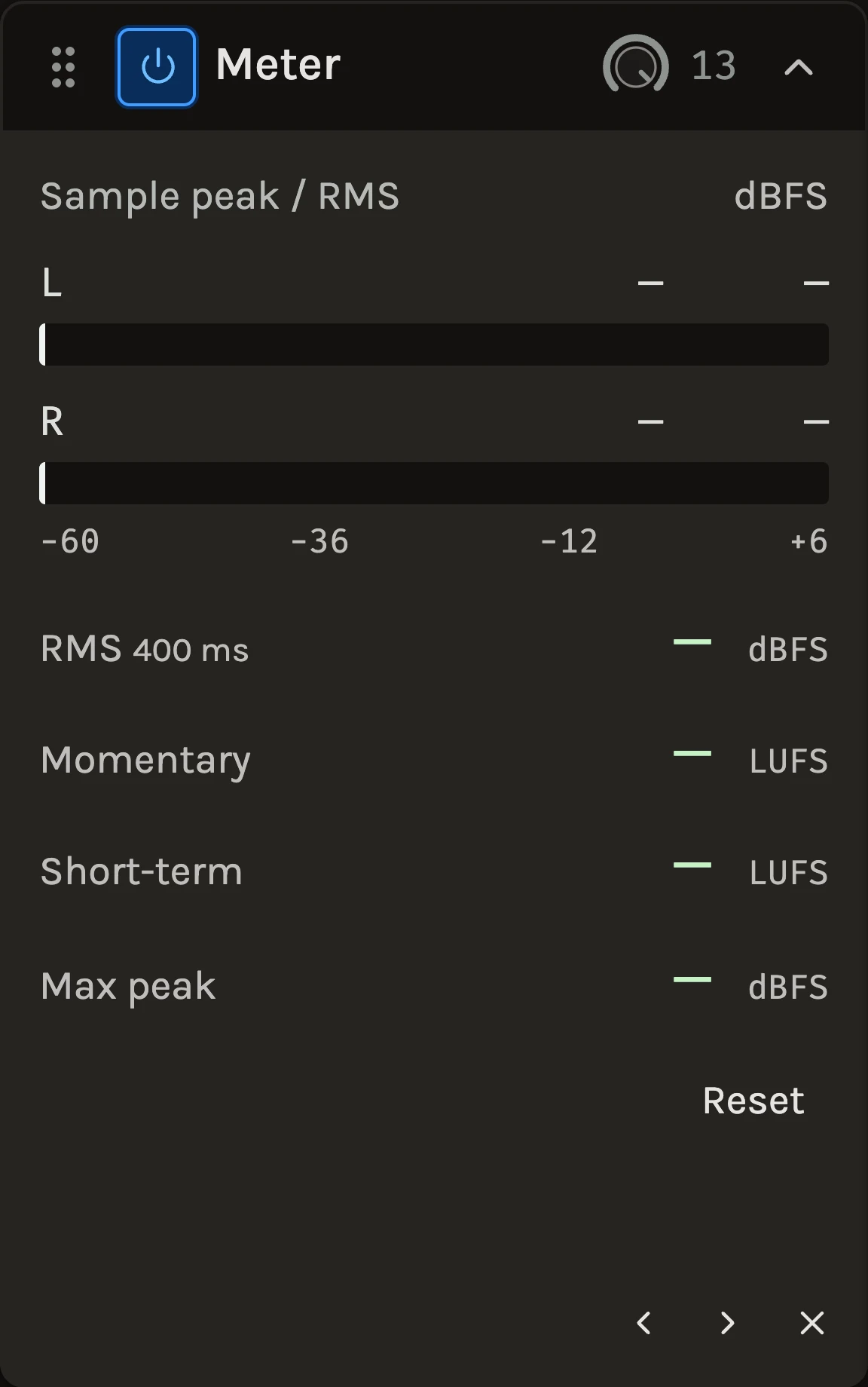
The Meter reads the level wherever you place it in an effects rack: sample peaks and RMS per channel, the two standard loudness readings in LUFS, and the highest peak since you last reset it. It changes nothing. Audio passes through untouched and the module is left out of rendering, so a raw export stays exactly what went in.
When to use it
Drop one after a compressor to see what it did to the peaks, before a limiter to see how hard you are hitting it, or at the end of the Master to check the loudness of the whole mix against a target before export. Two meters around an effect show the level it adds. For a picture of the frequency balance rather than the level, use the Spectrum analyzer; to change the level, use Gain.
Controls
Sample peak / RMS
One bar per channel, L and R or Mono. The bright part is the sample peak and the darker fill is the RMS, with a falling peak-hold marker and two numbers: the held peak and the 400 ms RMS. The scale runs from −60 to +6 dBFS.
RMS
The mean energy across both channels over 400 ms, unweighted. A full-scale sine reads −3 dBFS.
Momentary and Short-term
Loudness in LUFS, weighted the way the ear hears: Momentary over the last 400 ms, Short-term over the last three seconds. Short-term is the number to watch while a section plays; streaming services and broadcast targets are quoted in this unit.
Max peak
The highest sample peak since playback started or since the last reset. It turns red above 0 dBFS. The small caption shows how many seconds have been measured.
Reset
Clears the maximum and the measurement time. The numbers refresh four times a second so they can be read; the bars move live.
Tips
- Judge a mix by Short-term loudness during the loudest section, not by peaks: two mixes with the same peaks can differ by 10 LU.
- Reset before playing a section from the top so Max peak describes that pass alone.
- Bypassing the meter clears its readout, so a bypassed module never shows a stale number from an earlier pass.
Keep shaping your sound.
There’s a whole rack to explore.