Guitar amp
A tube amp from the input jack to the room, with breakup, sag, speaker and cabinet.
Open the studio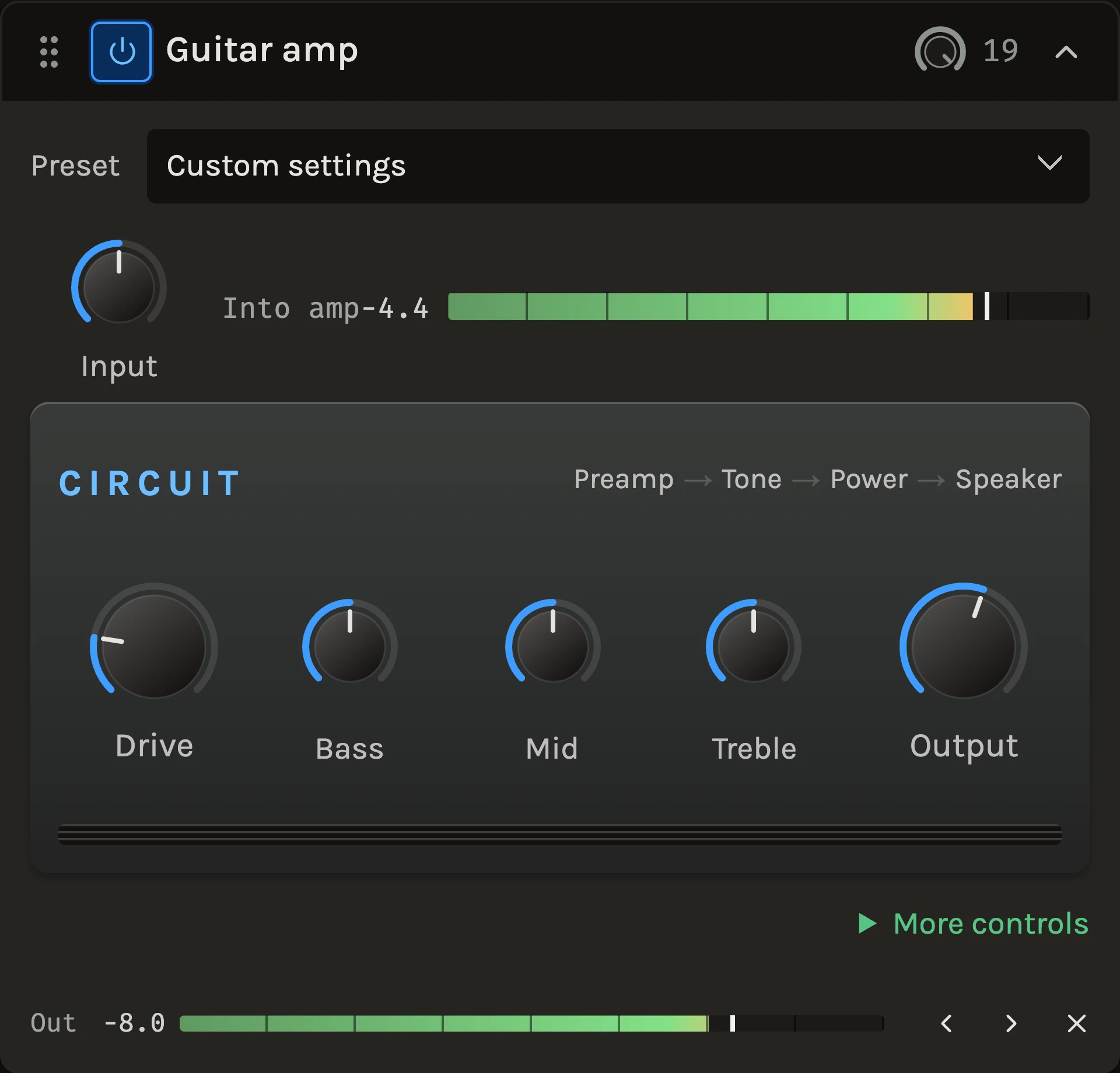
The Guitar amp is a complete signal path: input trim, preamp, tone stack, power stage with sag, speaker, cabinet and room. Turn Drive up and the preamp breaks up; play hard into it and the power supply sags under sustained notes. The speaker rolls off the fizz, the closed cabinet adds its box, and a small room puts a microphone in front of it. Four templates, Clean, Edge, Lead and Dry lead, give a starting point.
When to use it
Use it on a direct guitar or bass, on a synth that wants an edge, or on drums and vocals for a wrecked, mic’d-in-a-room sound. With live input monitoring on an armed track you can practise through it. For tape and console colour rather than an amp, use the Color Box; to run the amp into a real captured cabinet, follow it with the Convolver.
Controls
Input
Trims the source before the amp. The Into amp meter shows the peak after the trim and before Drive; set it so clean playing sits around −18 dBFS, then use Drive for breakup.
Drive
Pushes the preamp into breakup, up to 60 dB. Clean and edge-of-breakup live in the first third; the Lead preset sits at 26 dB.
Bass, Mid and Treble
The tone stack, placed before the power stage. Its zero position already has an amp’s scoop, so flat controls sound like an amp rather than an EQ. Boost or cut up to 12 dB each.
Output
The final listening level. Drive is not compensated, so bring Output down as Drive goes up.
Power
Sag softens the power supply under sustained signal, so held notes compress and bloom. Resonance is the low thump where the speaker’s impedance peaks; Presence is the upper bite from the same rise above 2 kHz, placed before the speaker so it becomes a peak rather than fizz.
Speaker
Brightness opens or darkens the modelled speaker, from 2.5 to 8 kHz. Cabinet depth adds the standing waves inside a closed box; zero is an open baffle.
Room
Room sets how much of the room around the speaker you hear: floor and wall reflections plus a short tail. Zero is a dead room and adds no tail. Room size moves from a booth to a live room.
Tips
- Set Input first with the meter, then Drive, then Output. Changing Drive at the wrong input level tells you little about the amp.
- For a double-tracked sound, duplicate the track and give one copy a slightly different Brightness and Room size rather than a different Drive.
- Cabinet depth and Room are the difference between an amp in an anechoic chamber and one in a studio; if a preset sounds thin, raise them before touching the tone stack.
All control ranges 13 controls
| Control | Range |
|---|---|
| Input | -24 to 24 dB |
| Drive | 0 to 60 dB |
| Output | -36 to 6 dB |
| Bass | -12 to 12 dB |
| Mid | -12 to 12 dB |
| Treble | -12 to 12 dB |
| Sag | 0 to 100% |
| Resonance | 0 to 100% |
| Presence | 0 to 100% |
| Brightness | 2500 to 8000 Hz |
| Cabinet depth | 0 to 100% |
| Room | 0 to 100% |
| Room size | 0 to 100% |
Keep shaping your sound.
There’s a whole rack to explore.