8 October 2026
Why I'm making Dr. Tape
Thirty years of making music on computers, an old hard drive with four hundred songs on it, and what it all taught me about the studio I wanted.
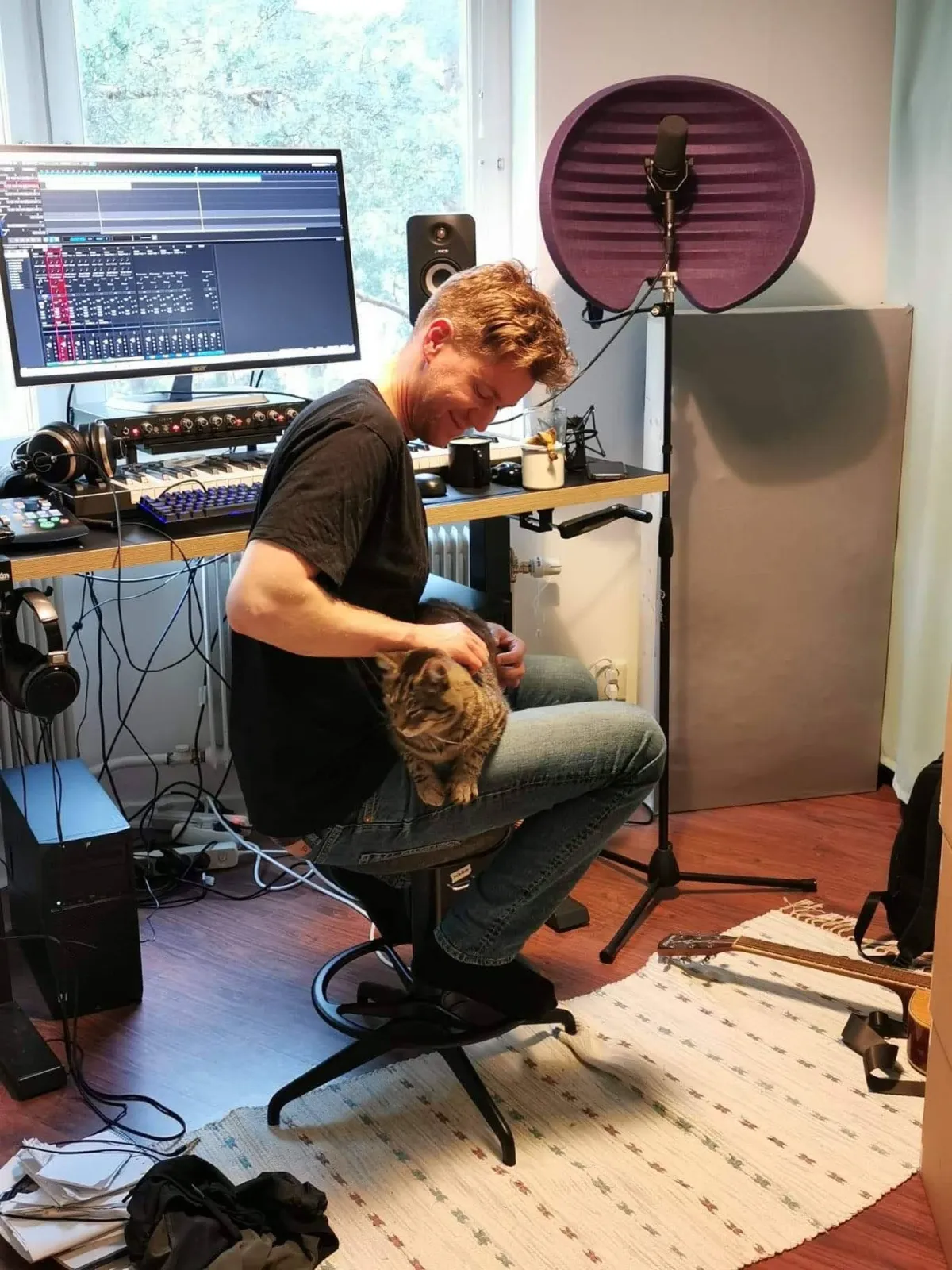
About eight years ago I was visiting my childhood home and found an old hard drive. I plugged it in. On it were around four hundred songs and song sketches, dated across four or five years, from when I was thirteen or so until I was eighteen. A new idea every few days, for years on end. And that was only what had survived. The years before it went with an older computer.
I sat there going through them and kept wondering who this person was. He must have been obsessed. Where did he go?
This post is my answer to that question, and the reason I am building Dr. Tape.
A tracker and a big brother
I’m thirty-nine. The first music I made on a computer, I made at six or seven, on my big brother’s machine. He is a tremendously talented musician who went on to study singing and music production, and he was my idol in the way only a big brother can be. Once in a while, after enough begging, he let me use his tracker. ModPlug Tracker, if I remember right.
A tracker is a spreadsheet for music. Notes and effect commands go into columns, and the song scrolls past row by row. Making a song that way took forever. It was also the most exciting thing I had ever seen. You had samples, a few early synthesizer tricks, and you could build a whole piece of music out of a few hundred kilobytes. Some of those mid-nineties songs are, as far as I know, still out there in the internet’s archives. That is a strange thing to know.
I was hooked. When I was around eight I got a computer of my own, and from then on I could make music whenever I wanted, which was most of the time.
Reason, Cubase and the rack
Not long after came Reason, from Propellerhead in Sweden, somewhere around version 2. I have used every version since, up to 14. Then Cubase, which was my main studio through all of my teenage years. For a long time I ran the two together over ReWire, with Reason’s instruments playing inside a Cubase project. Having both at once felt like a superpower.
Looking back, my first years of making music were spent in a tracker and in a rack of virtual hardware, not in a timeline with a mixer underneath it. That shaped how I think a studio should feel. The rack taught me how good it is to have every tool on one page, where all you ever do is scroll and tweak.
Dr. Tape has two layouts for exactly this reason. Split is the familiar arrangement of most desktop studios, with the timeline on top and one tool below it. Rack puts the sequencer, the piano roll, the instrument, the effects and the mixer on one scrolling page. Rack is the one I use myself. It is the fastest way I know to work on a song, because nothing is ever more than a scroll away. Which one suits you depends on what you are used to and how much screen you have, so both are there.
A song every few days
Through my teens I made a lot of electronic music, and until I was seventeen I also played in a band, punk and rock and heavier things. I grew up listening to everything from jazz to film scores, and film music is still one of my favourite genres. It carries so much emotion without a single word. To me music has always been about emotion, first and last.
Then came university, and the music faded. I dabbled, but the studies took over. I was a broke student, so I sold the studio one piece at a time, the sound card, then the keyboard, then the rest. The room got emptier and emptier. When working life started there was even less time. I kept up with music, but not like before.
Then came the hard drive.
Coming back
What I understood, going through those four hundred songs, was that music is the one thing that has never stopped giving me something new to learn. How instruments work. How playing technique carries emotion. How to arrange parts so they fit together. And then production, which is endless. One of my biggest pleasures has always been finding out how an effect works. The timing of a compressor changes the feel of a part. The smallest turn of a reverb’s wet and dry balance changes what the whole song feels like. It is all about learning to sense that, and there is no end to it.
So I started again. A friend and I picked up a music project, and we have taken it seriously ever since. We have a band now and have released more than twenty songs together, around full-time jobs. I produce constantly, and I am still learning.
The other half
The same big brother taught me BASIC on a Commodore 64 before I started school. I like to say I learned to type before I learned to write by hand, which is nearly true. Through my teens, in the late nineties and early 2000s, I programmed about as much as I made music, small apps and games and whatever utility we were missing. I helped build one of the first programming communities in Finland and was in charge of how it looked. I never meant to become a developer. I just loved the feeling of making the computer do the work and arriving at something that worked.
For as long as I can remember, one of my dreams has been to make music software. I had dabbled, with a few plugins of my own and once an audio compression scheme that took about a fifth off the size of a file without anything you could hear. Fun, but I never took it further. This summer I realised the time had come to take it seriously and build the studio I had always wanted.
What thirty years of studios taught me
I own full licences for Cubase, Logic, Studio One, Ableton Live, Bitwig, Reason, Harrison Mixbus and REAPER, and REAPER has been my daily studio for about six years. I have used most of the browser studios too, from BandLab to Soundtrap and openDAW. The one major studio I have never used is Pro Tools. I never wanted to learn it.
When I learn a tool I learn it properly, so in most of these I would call myself a power user rather than a visitor. That puts me in an unusual position. I am not married to any one way of working. I have seen what each system does well and where each falls short, and over the years that turned into a kind of library of what a musician actually needs, and roughly what they don’t.
Dr. Tape is what came out of that library. It is opinionated. It curates a set of instruments and effects that covers a very wide range of needs, and it builds a workflow that is simple and direct on the surface and deep underneath. Some of it I have not seen in this form anywhere else:
- The groove engine changes the feel of a whole part from the track’s G button, and leaves the notes straight for you to edit.
- The chord track is one row of chords above the song, and every part that follows it plays the right notes. Hearing “what if this were minor” takes one click.
- ChordPad puts a circle of fifths beside the notes, for sketching a progression before you can play it.
- Comping lets you record take after take, then choose the phrases you like with a hover and a click. Nothing is ever replaced, and every recording stays underneath. It is the fastest way to comp a vocal I have used, and it gives up no features to be that simple.
- Convert audio to notes turns a melody hummed into a microphone into an editable MIDI clip.
And the things you expect are there, with less ceremony. Can you nest tracks into groups? Yes. Send to a shared reverb? Yes. Sidechain the bass compressor from the kick? Yes, from a picker in the effect’s header. Many studios make you learn a routing diagram for this. In Dr. Tape it is usually the simplest implementation that serves nearly every real use. It may stop you from building one very custom setup, and that is a trade I make on purpose.
Simple on the surface, deep underneath
My rule for the whole app is that it should be simple, seamless and good to look at, with the power right there when you want it and out of the way when you don’t.
Open the Bell EQ and you get one point to drag on a curve, and nothing else. Open the Parametric EQ and you get eight bands with the live spectrum behind them. The Compressor looks like any compressor, until you switch it to Advanced and find peak and RMS detection, linked or independent stereo, auto release and a five-band EQ on the detector, which I have not seen built in anywhere else. All of this runs in a browser tab. I still find that slightly hard to believe, and I built it.
Where it falls short today
Dr. Tape does not ship with loops, and its shelf of ready-made content is thinner than in many studios. There is a sound library of sampled instruments and a few hundred authored presets, but no construction kits and no bank of phrases to drag in. Getting a good sound out of it faster is the next thing I want to work on.
Part of that is a choice, though. One of the things I most want to give people is the pleasure of discovering their own sound, and that is why Dr. Tape is not a loop-based studio.
Soundtrap is a good example of the other road. It is a very well-made tool, robust, stable and beautiful, with good production-grade instruments. Its approach folds most of the choices into loops and presets, so you can make something quickly, and it will sound good. I think it comes at a cost. You never get to find out how production and composition actually work. I want Dr. Tape to be as clear and welcoming as that, with the depth of a desktop studio underneath.
Tools that help, but don’t do it for you
Dr. Tape is full of helpers for composing. The beat editor, the groove engine, the arpeggiator, the strummer, the chord track and ChordPad all make writing faster. None of them write the music for you.
I work with AI and automation in my day job, and I feel strongly about this one. A tool that picks the chords for you or builds the drum track on its own does work, and the result can sound good. But it takes away the pleasure of making the music yourself, the sense of achievement when you placed every hit, and the serendipity that so much good music comes from. The wrong click. The accident that was not what you meant and turned out better. Where the computer can take a chore off your hands, like cleaning up a noisy recording or, later, pulling a mix apart into stems, I am all for it. The music stays yours.
So Dr. Tape asks a little more of you than a studio built to be as simple as possible. There is a learning curve. At the end of it stands the pleasure of being able to say I did this, and this is my sound.
The person on that hard drive would have loved it. I am building it for him, and for you.