Pitch shifter
Transpose anything, chords included, and decide whether the voice travels with the notes.
Open the studio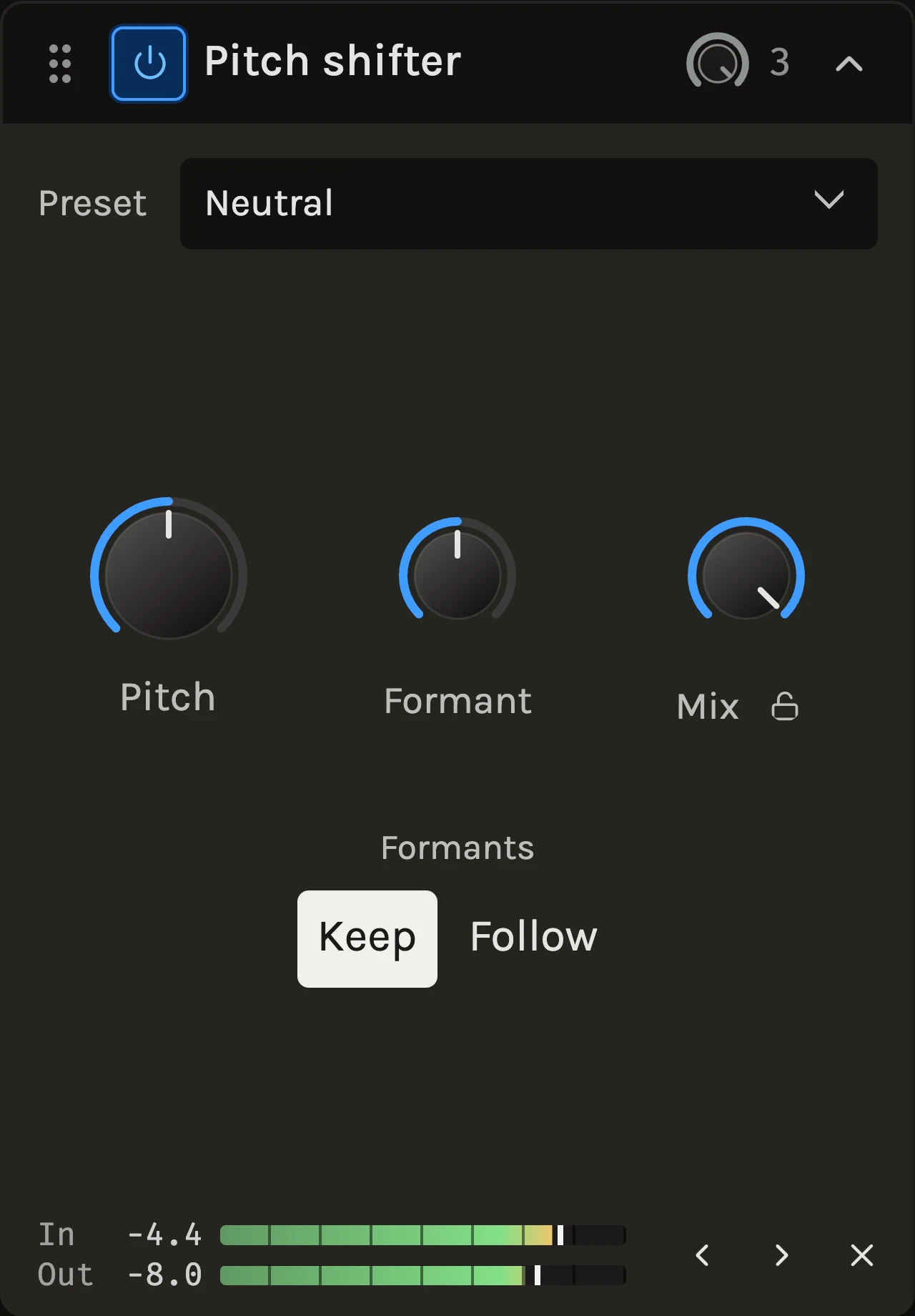
The Pitch shifter moves every note in a recording by the same interval, from two octaves down to two octaves up, and lets you decide what happens to the character of the voice while it moves. It works on chords and whole mixes as well as single lines, because it shifts the spectrum rather than tracking one note.
When to use it
Use it for a harmony under a vocal, an octave below a bass, a detuned double to thicken a lead, or to make a voice larger or smaller without changing its notes. The presets cover those jobs: Neutral, Vocal up, Vocal down, Octave, Fifth harmony, Larger voice, Smaller voice and Double. To pull sung notes onto a scale rather than move them all, use Pitch correction. For a MIDI part, transpose the notes in the piano roll instead.
Controls
Pitch
The transposition in semitones, −24 to +24. Dragging and the arrow keys move by whole semitones; hold Shift for cents, or type a decimal such as 0.08 for a fine detune. Shifts beyond a fifth are creative effects and may reveal artifacts on complex material.
Formant
Moves the broad resonances that make a voice or instrument sound like itself, without moving the notes. Lower tends toward a larger, darker source; higher toward a smaller, brighter one. Zero keeps the original character in Keep, or follows Pitch in Follow.
Formants
Keep leaves the character where it is, so a shifted voice still sounds like the same singer; it is the natural choice for harmonies. Follow moves the character with the notes, like changing tape speed: smaller when shifted up, bigger when shifted down. The Formant knob adds its offset in either mode.
Mix
Blends the original with the shifted copy; both are time aligned. 100% transposes. A partial mix adds a fixed harmony or a double, so the Fifth harmony preset uses 40% and Double uses 50%.
Tips
- For a double, a Pitch of 0.08 semitones at 50% Mix thickens a lead without an audible second voice; widen it with a Chorus afterwards if you want stereo.
- An octave down with Follow on gives the slowed-tape bass sound; the same shift with Keep stays the same instrument an octave lower.
- The shifter reports its latency to the engine, so tracks and sends stay aligned and exports are trimmed; while monitoring live you will hear the delay of about a tenth of a second.
All control ranges 3 controls
| Control | Range |
|---|---|
| Pitch | -24 to 24 st |
| Formant | -12 to 12 st |
| Mix | 0 to 100% |
Keep shaping your sound.
There’s a whole rack to explore.