Dr. Tape Wavetable
Shapes that move under an envelope, not just a filter that opens.
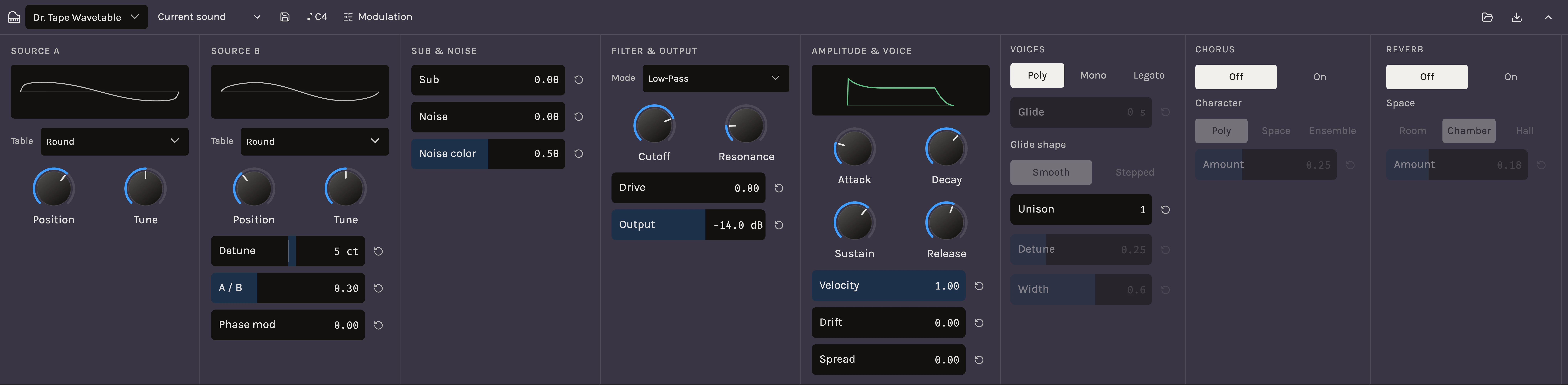
The Wavetable is the deeper synth. Each of its two sources plays one of nine table families, and Position moves through sixteen shapes inside that family, so a sound can change its harmonic makeup over a note rather than only its brightness. Source B can bend the phase of source A for bells and electric pianos, a sub and noise sit underneath, and eight modulation slots route envelopes, LFOs, velocity and key position to almost any control.
When to use it
Use it for evolving pads, textures that move on their own, bells and metallic keys, synced leads and shaped basses. The presets span Poly, Keys, Bass, Plucks, Rhythmic, Pads, Leads and Textures, each with playing advice in the Preset browser. For a fast subtractive sound, the Synth gets there with fewer decisions.
Controls
Source A and Source B
Table chooses the family. Round, Reed and Glass grow richer with Position; Shapes morphs sine to pulse by way of triangle, saw and square; Vowel slides through the vowels; Sync, Fold and Resonant raise a sync ratio, a wavefolder and a formant; Grain morphs random partials from dark to bright. Position is the control to modulate. Tune, Detune and A / B set the sources against each other, and Phase mod lets B bend A: tune B to 12, 19 or 24 semitones for the classic ratios and give the depth an envelope for a bright attack.
Sub & noise
Sub is a sine an octave below source A; Noise has a Noise color from dark to white. Both pass through drive and the filter.
Filter & output
Mode is Low-pass, Low-pass 24, High-pass, Band-pass or Notch; changes blend smoothly. Then Cutoff, Resonance, Drive (saturation before the filter) and Output.
Envelopes
The Amplitude & voice envelope is the master loudness; its Velocity sets how much velocity scales it, so velocity can go to tone alone through the matrix. Drift adds slow tuning movement; Spread places successive notes across stereo. The Filter envelope, Source A envelope and Source B envelope are modulation sources; a source envelope’s Level depth lets it shape that source’s loudness on its own.
LFO 1 and LFO 2
Shape (Sine, Triangle, Saw, Square, Sample & hold or Drift), Phase (Note restarts with each key, Free runs continuously) and Rate. The steps in Square and Sample & hold, and the Saw’s return, take 3 ms rather than a single sample, so a gate or a stepped sweep keeps its rhythm without clicking. When a Mono line restarts a Note LFO, its output moves to the new start over the same 3 ms.
Modulation
Eight slots, each a Source, a Target and a bipolar Depth. A depth of 1 is the target’s full range: position ±1, tune ±12 semitones, cutoff ±6 octaves. Routes crossfade when changed, so editing while playing never clicks; the panel lists active routes under the sections they affect.
Voices
Voices is Poly, Mono or Legato, with Glide and a Glide shape (Smooth, or Stepped through semitones). Unison stacks up to four detuned copies per note, with Detune and stereo Width.
Chorus and Reverb
Finishing effects inside the instrument, off by default: Poly, Space or Ensemble chorus; Room, Chamber or Hall reverb.
Tips
- Start a patch by routing an envelope or LFO to A position; table movement is what sets this synth apart from a filter sweep.
- Key to Cutoff at depth 1 tracks the keyboard exactly.
- Unison copies cost as much as the sources they duplicate; try two with Width before reaching for four.
Control ranges
Voices
| Control | Range | What it does |
|---|---|---|
| Voices | Poly · Mono · Legato | Mono retriggers each note; Legato keeps envelopes running while keys overlap. Last held note takes priority. |
| Glide | 0 to 2 s, starts at 0 s | Time to reach the next note in Mono or Legato. Poly does not glide. |
| Glide shape | Smooth · Stepped | Smooth slides continuously; Stepped moves through semitones. |
| Unison | 1 to 4, starts at 1 | Detuned copies of both sources inside each note. Applies to notes started after the change. Twelve notes remain the limit; four copies cost four times the source work. |
| Detune | -50 to 50 ct, starts at 5 ct | Fine tuning of source B. |
| Width | 0 to 1, starts at 0.6 | Stereo placement of the copies. Zero keeps them centered on the note. |
Source A envelope
| Control | Range | What it does |
|---|---|---|
| Attack | 0.002 to 8 s, starts at 0.02 s | |
| Decay | 0.005 to 8 s, starts at 0.5 s | |
| Sustain | 0 to 1, starts at 0 | |
| Release | 0.005 to 8 s, starts at 0.4 s | |
| Level depth | 0 to 1, starts at 0 | How much this envelope shapes source loudness. Zero leaves loudness to the master envelope; one follows this envelope fully. |
Chorus
| Control | Range | What it does |
|---|---|---|
| Chorus | Off · On | |
| Character | Poly · Space · Ensemble | |
| Amount | 0 to 0.6, starts at 0.18 |
Reverb
| Control | Range | What it does |
|---|---|---|
| Reverb | Off · On | |
| Space | Room · Chamber · Hall |
Source A
| Control | Range | What it does |
|---|---|---|
| Table | Round · Reed · Glass · Shapes · Vowel · Sync · Fold · Resonant · Grain | Original families. Round, Reed and Glass grow richer with Position; Shapes morphs sine–triangle–saw–square–pulse; Vowel slides U–O–A–E–I; Sync raises a hard-sync ratio; Fold deepens a wavefolder; Resonant sweeps a phase-distortion formant; Grain morphs random-phase partials from dark to bright. |
| Position | 0 to 1, starts at 0.35 | Move through the shapes of source B. |
| Tune | -24 to 24 st, starts at 0 st |
Source B
| Control | Range | What it does |
|---|---|---|
| A / B | 0 to 1, starts at 0.3 | Balance the two sources. Zero is A only; one is B only. |
| Phase mod | 0 to 1, starts at 0 | Source B bends the phase of source A. Tune B to 12, 19 or 24 st for bell and electric-piano ratios; shape the depth with an envelope for a bright attack. Aliasing rises with depth at high pitches. |
Sub & noise
| Control | Range | What it does |
|---|---|---|
| Sub | 0 to 1, starts at 0 | A sine one octave below source A, mixed before drive and filter. |
| Noise | 0 to 1, starts at 0 | Noise mixed before drive and filter. Route Source A envelope to Noise for a breath at the attack. |
| Noise color | 0 to 1, starts at 0.5 | Zero is dark, one is white. |
Filter & output
| Control | Range | What it does |
|---|---|---|
| Mode | Low-pass · Low-pass 24 · High-pass · Band-pass · Notch | Low/high-pass: 12 dB/oct; Low-pass 24 stacks a second identical stage. Band-pass isolates a band; Notch removes it. Modes blend smoothly when changed. |
| Cutoff | 30 to 20000 Hz, starts at 4000 Hz | |
| Resonance | 0.5 to 4 Q, starts at 0.7 Q | |
| Drive | 0 to 2, starts at 0 | Soft saturation before the filter. Zero is clean; 1 is the original maximum. Above 1 adds up to 24 dB more push without further output attenuation. |
| Output | -36 to 0 dB, starts at -14 dB |
Amplitude & voice
| Control | Range | What it does |
|---|---|---|
| Velocity | 0 to 1, starts at 1 | How much velocity scales loudness. Zero plays every note at full level; route Velocity in the matrix for tone changes. |
| Drift | 0 to 1, starts at 0 | Slow independent tuning movement and small voice differences. Zero stays stable; full depth stays within seven cents per source. |
| Spread | 0 to 1, starts at 0 | Spread successive notes across stereo. Zero centers every note; a single note keeps its own position. |
LFO 1
| Control | Range | What it does |
|---|---|---|
| Shape | Sine · Triangle · Saw · Square · Sample & hold · Drift | Sample & hold steps to a new random value each cycle; Drift glides between them. Both are deterministic per note. |
| Phase | Note · Free | Note starts the LFO with each key and lets rate modulation act per voice. Free shares one continuous phase within this instrument at the base rate. |
| Rate | 0.02 to 20 Hz, starts at 4 Hz | Cycles per second. Modulate the rate from the matrix; tempo sync is not part of this iteration. |
Modulation
| Control | Range | What it does |
|---|---|---|
| Source | Off · Amp envelope · Filter envelope · Source A envelope · Source B envelope · LFO 1 · LFO 2 · Velocity · Key · Note random | |
| Target | A position · B position · A tune · B tune · Blend · Cutoff · Resonance · Drive · Level · Pan · LFO 1 rate · LFO 2 rate · Phase mod · Sub · Noise · Unison detune | |
| Depth | -1 to 1, starts at 0 | Bipolar depth. One is the full range listed for the target: position ±1, tune ±12 st, cutoff ±6 oct, resonance ×4, LFO rate ×8, others ±1. |
13 factory presets.
See also
Changes
- FixedStepped LFOs in the Wavetable no longer click · 9 October 2026
A Square or Sample & hold LFO, and a Saw at the end of each cycle, used to move its target in a single sample, which crackled on Level, a table position, pan or pitch. Each step now takes 3 ms, so gates, ratchets and stepped sweeps keep their rhythm without the clicks. A Mono line that restarts a Note LFO with each key now moves to the restart over the same 3 ms instead of jumping. Patches that don't use these shapes, and every Poly patch, sound exactly as before.
- FasterWavetable playback uses less processing power · 3 October 2026
Wavetable tracks use less processing power during playback, including dense chords and unison voices. The sound, modulation, glide, finishing effects and loop crossfades stay the same; live control changes keep their existing smoothing.