Dr. Tape Drums
From a clean electronic box to a drum with a stretched head and buzzing wires.
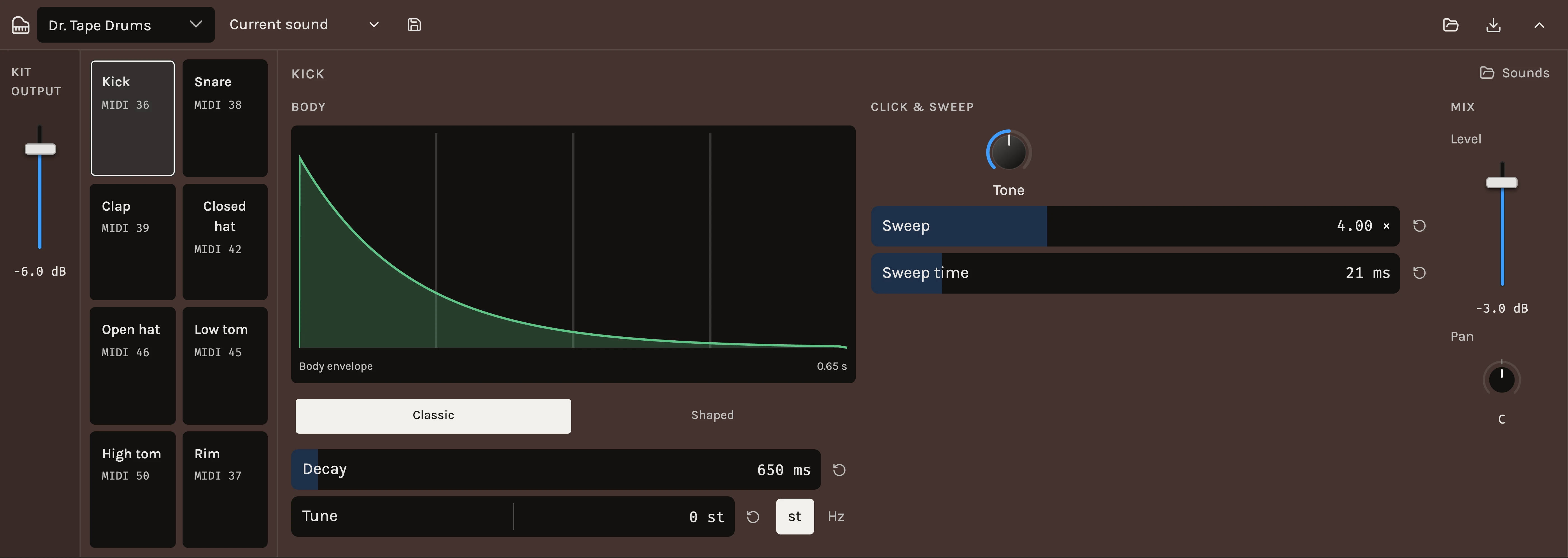
Nothing in the Drums is a recording. Each voice is calculated when it is hit: a sine with a pitch sweep for the kick, noise bursts for the clap, a bank of metal partials for the hats. Several voices offer a choice of character, from the Classic electronic model to physical ones: a snare with a modeled head whose pitch drops as it stretches on a hard hit, and wires that leave the bottom head and slap back. Velocity changes the sound, not only the volume.
When to use it
Start with a kit preset: Studio uses the Crack snare, Classic box and Tight circuit stay electronic, Wood room puts a Skin snare with Buzz wires and Skin toms in front of Alloy hats. Each pad has its own Level and Pan, and the Preset browser can swap a whole kit or one drum at a time. Fit the hits to the pocket with Groove.
Controls
Kick
Tune, Tone (the attack click), Decay and Level. Sweep depth is how far above the base pitch the hit starts and Sweep time how quickly it falls: short is a tight attack, long is an audible drop. Envelope chooses the Classic exponential fade or Shaped, which adds Attack, Hold and a Curve for long, sustained kicks.
Snare
Body chooses the model. Classic is two electronic partials. Crack layers two distorted partials with a pitch drop, bright held noise, a click and compensated Drive; its Body, Snap and Punch set ring time, noise length and how far the hit starts above pitch. Skin is a modeled membrane: Diameter and Tension set pitch and overtone spacing, Damping shortens ringing, Strike position moves from centre to edge, Stick makes soft hits rounder and hard hits brighter, Pitch drop lets hard hits start sharp and settle, and Body weight adds a low thump. Wire character picks Classic or Resonant noise, Rattle, or Buzz, where Wire tension and Contact decide how easily the wires chatter and Snare head tunes the bottom head. Wires balances them against the body; Sizzle adds the coils’ shimmer.
Clap
Spread goes from a tight handclap to a wider group of hands, with Tune, Tone and Decay.
Closed hat and Open hat
Metal character is Classic or Alloy; the open hat adds Bell, a struck bank of decaying resonances. Metal sets how much of the metallic generator you hear against the noise, Tone moves it dark to bright, Decay sets the length. The two hats choke each other.
Low tom and High tom
Body is Classic or Skin. Skin shares the snare’s membrane with Diameter, Tension, Damping, Strike position and Stick; Punch is the Classic pitch sweep or, on Skin, how far a hard hit starts sharp.
Rim and Kit
The rim has Body, Tone, Tune and Decay. Output trims the kit before the track’s effects.
Tips
- Changes to a model’s geometry apply to the next hit, so a sounding tail is never cut while you turn a knob.
- On a Skin snare, start with Pitch drop around 0.4 and Buzz wires, then set Wire tension by how loud a ghost note has to be before the wires answer.
- A hit never shortens with the MIDI note; use Decay for length.
Control ranges
Kick
| Control | Range | What it does |
|---|---|---|
| Tune | -12 to 12 st, starts at 0 st | Pitch of this drum voice. |
| Tone | 0 to 1, starts at 0.5 | Dark to bright. Harder hits also brighten the transient. |
| Decay | 0.03 to 3 s, starts at 0.24 s | Wire noise tail length for Classic and Resonant characters. |
| Sweep depth | 0 to 12 ×, starts at 4 × | Initial pitch rise above the tuned base frequency. Zero gives no pitch sweep; 4 starts at five times the base frequency. |
| Sweep time | 0.001 to 0.15 s, starts at 0.021 s | Time constant of the pitch drop. Short is a quick attack; long gives an audible falling pitch. |
| Envelope | Classic · Shaped | Classic exponential fade or an attack/hold/decay envelope for sustained kicks. |
| Attack | 0.001 to 0.5 s, starts at 0.001 s | Time for the shaped body to reach full level. The click stays independent. |
| Hold | 0 to 2 s, starts at 0 s | Time the shaped body stays at full level before decaying. |
| Curve | 0 to 1, starts at 0.5 | Contact activity fade: left is closer to linear; right drops faster at first with an exponential tail. Shapes the wire punch without adding a second volume envelope. |
| Level | -60 to 6 dB, starts at -8 dB | Per-drum level; −60 dB mutes this pad. |
| Pan | -1 to 1, starts at 0 | Left to right, with constant-power panning. |
Snare
| Control | Range | What it does |
|---|---|---|
| Body | Classic · Skin | Classic electronic body or modeled membrane. Skin geometry is captured when each hit starts. |
| Snap | 0 to 1, starts at 0.35 | Skin only: adds a bright strike and a brief dense initial response. Zero keeps the existing body; the later tail is unchanged. |
| Punch | 0 to 1, starts at 0.5 | Crack only: how far the body starts above pitch and how much extra crack the first 20 ms get. Harder hits punch more. |
| Drive | 0 to 1, starts at 0.25 | Crack only: compensated soft clipping on the whole snare. Zero is clean. |
| Amount | 0 to 1, starts at 0.7 | Audible body level. Zero isolates the wires without stopping their excitation. |
| Body weight | 0 to 1, starts at 0.35 | Skin only: adds a short, low body thump beneath the membrane. Zero preserves the skin alone. Diameter sets its size; wires are unaffected. |
| Diameter | 8 to 18 in, starts at 10 in | Skin only: larger heads lower pitch, sustain longer and change the overtone balance for a fixed-size strike. Applies to new hits. |
| Tension | 0.35 to 3 ×, starts at 1 × | Skin only: tension changes pitch, overtone spacing and higher-mode losses. Tune can compensate the pitch. Applies to new hits. |
| Damping | 0 to 1, starts at 0.35 | Skin only: shortens ringing, especially higher modes. Applies to new hits. |
| Strike position | 0 to 0.85, starts at 0.3 | Skin only: centre to edge, changing which membrane modes are excited. Applies to new hits. |
| Stick | 0 to 1, starts at 0.5 | Skin only: stick contact time. Soft hits linger on the head and sound rounder; hard hits are short and bring out the upper modes. Zero keeps the fixed balance. Applies to new hits. |
| Pitch drop | 0 to 1, starts at 0.4 | Skin only: hard hits start sharp and settle to pitch as the stretched head relaxes. Velocity sets the depth; zero keeps the head at pitch. Applies to new hits. |
| Wires | 0 to 1.75, starts at 1 | Noise level. Set to zero to hear the body alone. Crack: balance from body to wires. |
| Sizzle | 0 to 1, starts at 0.4 | Buzz only: how much the wire coils ring after each slap, a short high shimmer over the contact noise. Zero is the plain contact sound. |
| Wire tension | 0 to 1, starts at 0.45 | Rattle: loose, broader contacts to tight, short, bright contacts. Buzz: how hard the strainer holds the wires to the head; loose wires chatter on faint motion, tight wires only crack on a hard stroke. Applies to new hits. |
| Contact | 0 to 1, starts at 0.55 | Rattle and Buzz: increases contact with the skin, allowing quieter vibrations to excite the wires. |
| Snare head | 0 to 1, starts at 0.4 | Buzz only: bottom head tuning relative to the batter head, from matched to well above it. Applies to new hits. |
| Wire character | Classic · Resonant · Rattle · Buzz | Classic noise, Resonant filtered noise, membrane-driven Rattle, or Buzz: wires that leave and slap a modeled bottom head. Changes apply to new hits. |
| Resonance | 0 to 1, starts at 0.35 | Resonant character only: broad noise to a narrow ringing band. Tone moves the band from low to high. |
Clap
| Control | Range | What it does |
|---|---|---|
| Spread | 0 to 1, starts at 0.5 | Tight handclap to a wider group of hand impacts. |
Closed hat
| Control | Range | What it does |
|---|---|---|
| Metal character | Classic · Alloy · Bell | Classic or Alloy layers; Bell is a struck bank of decaying resonances. Bell Tune, Tone, Metal and decay coefficients apply to new hits; decay cutoff stays live. Metal lengthens high ringing. |
| Metal | 0 to 1, starts at 0.5 | Shape the balance and attack of this voice. |
Kit
| Control | Range | What it does |
|---|---|---|
| Output | -36 to 0 dB, starts at -6 dB | Kit output before the track effects. |
7 factory presets.
See also
Changes
- FasterLower playback load for the drum machine · 3 October 2026
The drum machine uses less processing power during busy patterns, including modeled skins, wire snares and metallic hats. Its hits, hat choking, tuning and complete decay tails keep the same sound.