Dr. Tape Strings
A bow on a string, with the player's hand still in it.
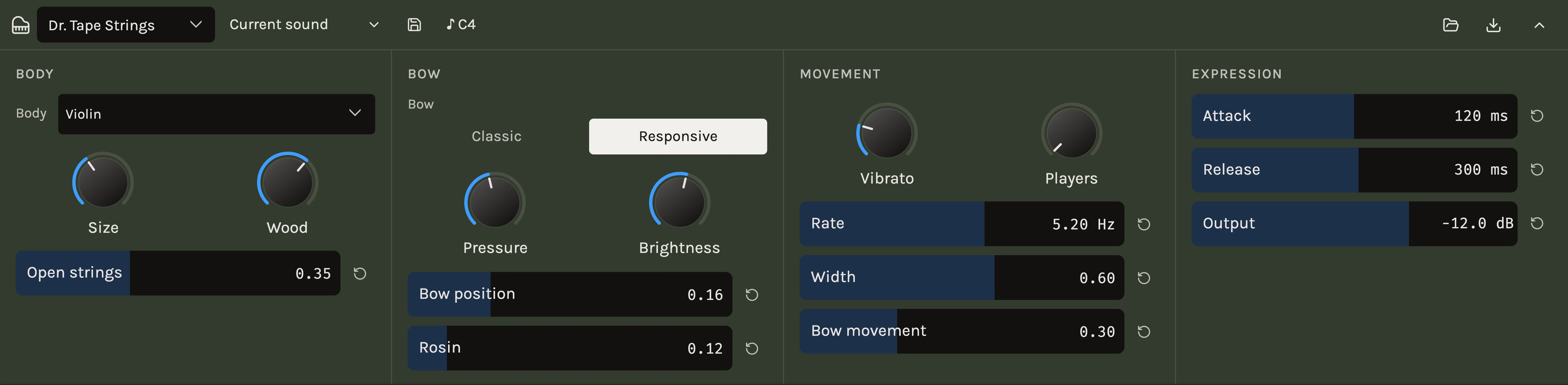
The Strings bow a modeled string against a modeled body. Nothing is sampled: the bow’s friction, the bridge, the wood and the player’s left hand are calculated for every note. Velocity becomes bow speed and force, so a loud note is brighter and starts with more scratch, not just more level. Notes that overlap in the piano roll become slurs on one string, long notes change bow direction on their own, vibrato fades in like a hand, and the four open strings ring along underneath. With more than one player, each has their own bowing, tuning and seat.
When to use it
Use a single player for a solo line, a duo for a counter-melody, or four to eight players for a section. The presets are split into Solo (violin, viola, cello and bass), Ensemble (Chamber strings, Silk section) and Character sounds such as At the bridge and Frozen wood. Write slurs by overlapping notes slightly; separate notes re-articulate. Chords never slur.
Controls
Body
Body picks Violin, Viola, Cello or Bass resonances; it changes colour, not pitch, so a cello body on a high line is a legitimate choice. Size moves the wood and air resonances lower or higher. Wood sets how strong the body resonances are. Open strings is the sympathetic ringing of the instrument’s four open strings, heard as a halo under the tone and a soft after-ring when the bow stops.
Bow
Bow is Classic, where velocity is level only, or Responsive, the default, where velocity drives speed, force, brightness, attack time and rosin. Pressure goes from light contact to a firm grip. Bow position nearer the bridge is brighter and more nasal. Brightness damps the upper harmonics. Rosin is the irregular friction noise, loudest as the bow starts.
Movement
Vibrato is the depth in cents and Rate its speed; it fades in after the attack and breathes over a long note. Players sets how many independent players share the part, each with their own onset, tuning and vibrato. Width spreads their seats across the stereo field; one player always sits in the centre. Bow movement adds slow, irregular drift of pressure, position and brightness.
Expression
Attack is the time for the bow to reach speed; loud notes get there faster. Release is how long the string takes to settle after the bow lifts. Output trims the level.
Tips
- For a legato line, extend each note a little into the next in the piano roll. The string glides to the new pitch and a finger noise marks the change.
- Section sounds come from Players, not from effects: four players with Width 0.6 already sit as a group with their own vibrato rates.
- Keep Attack short for the solo player and let Responsive velocity shape the onset; a longer Attack on a section gives the swell of a real ensemble.
Control ranges
Body
| Control | Range | What it does |
|---|---|---|
| Body | violin · viola · cello · bass | Different resonant bodies. This changes the color, not the MIDI pitch. |
| Size | 0.65 to 1.6 ×, starts at 1 × | Larger bodies move the wood and air resonances lower. |
| Wood | 0 to 1, starts at 0.65 | Strength of the body resonances and radiation. Large bodies retain more low-frequency weight. |
| Open strings | 0 to 1, starts at 0.35 | Sympathetic ringing of the four open strings, fed from the bridge. Heard as a halo under the tone and a soft after-ring. |
Bow
| Control | Range | What it does |
|---|---|---|
| Bow | classic · responsive | Classic uses note velocity as level only. Responsive turns velocity into bow speed and force: louder notes bow faster, brighter, with a quicker attack and more rosin. |
| Pressure | 0 to 1, starts at 0.45 | Changes the bow/string friction: light contact to a firmer grip. |
| Bow position | 0.06 to 0.45, starts at 0.16 | Near the bridge gives a brighter, more nasal sound. |
| Brightness | 0 to 1, starts at 0.55 | Damping of the upper string harmonics. |
| Rosin | 0 to 1, starts at 0.12 | Irregular bow friction, especially audible as the bow starts. |
Movement
| Control | Range | What it does |
|---|---|---|
| Vibrato | 0 to 40 ct, starts at 9 ct | Pitch movement fades in after the bow attack. |
| Rate | 0.2 to 9 Hz, starts at 5.2 Hz | Speed of the vibrato. |
| Players | 1 to 8, starts at 1 | Independent players, each with their own bowing, onset, tuning and body variation. |
| Width | 0 to 1, starts at 0.6 | Stereo spread of the players’ seats. A single player is always centered. |
| Bow movement | 0 to 1, starts at 0.3 | Slow, irregular movement of bow pressure, contact position and brightness. Zero keeps these steady. |
Expression
| Control | Range | What it does |
|---|---|---|
| Attack | 0.005 to 3 s, starts at 0.12 s | Time for the bow to speak. |
| Release | 0.02 to 4 s, starts at 0.3 s | Time for the string to settle after releasing a note. |
| Output | -36 to 0 dB, starts at -12 dB | Instrument output level. |
10 factory presets.
See also
Changes
- FasterStrings playback uses less processing power · 3 October 2026
Strings tracks use less processing power during playback, including full sections and rapid chords. Bow response, legato, sympathetic ringing and loop continuation keep the same sound, and live control changes keep their existing smoothing.