Dr. Tape Piano
A piano modelled from the hammer to the lid, with a pedal that blooms.
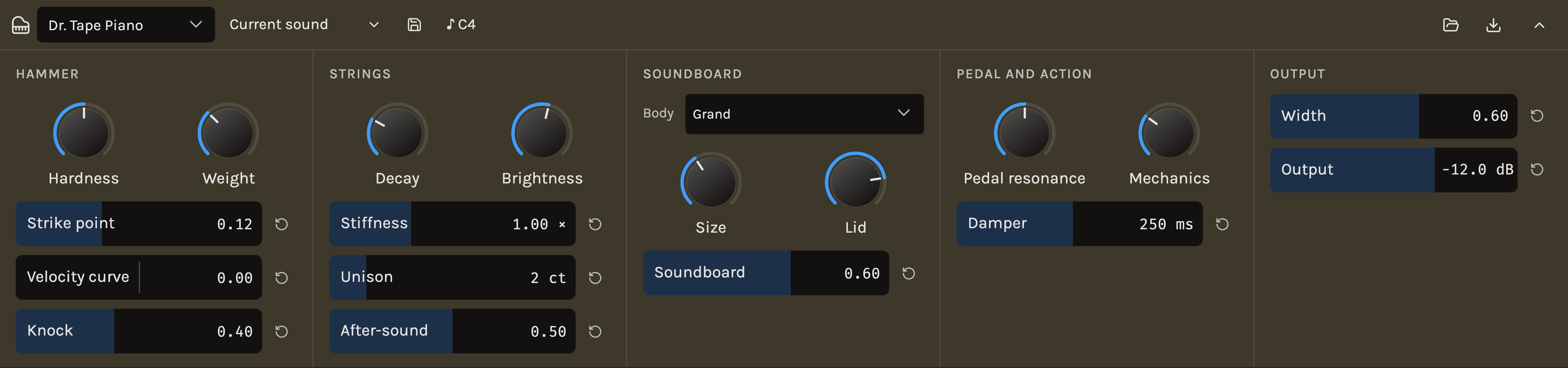
The Piano is a physical model: every key has a felt hammer, one to three strings, dampers and a soundboard, and nothing is sampled. Play softly and the hammer sinks into the string for a round tone; strike hard and the felt stiffens and the note bites. Hold the sustain pedal and the unplayed strings ring with what you play. Because the sound is calculated as you play, each control changes the instrument itself, not a recording of one.
When to use it
Use it wherever a real piano would go: a solo part, chords under a vocal, or a sketch you want to hear with real touch before deciding on anything else. The presets range from a concert grand to compact and upright pianos; start there and adjust the hammer and lid to the mix.
Controls
Hammer
Hardness is the felt: soft for a warmer, longer contact, hard for brightness that grows with velocity. Weight sets how much energy a strike pushes into the string. Strike point moves where the hammer lands; harmonics with a node at that point disappear, which changes the colour more than the pitch. Velocity curve bends your keyboard’s response: positive makes ordinary playing louder and brighter, negative keeps the top for the hardest strikes, and fortissimo stays the same either way. Knock adds the thud of hammer and keybed heard through the soundboard.
Strings
Stiffness stretches the upper partials sharp, from a perfectly harmonic string at zero to the bell-like top of a small piano. Unison detunes the two or three strings of each note, which gives the slow beating and the quieter after-sound. Decay scales how long undamped strings ring; Brightness sets how long the top end survives; After-sound is the bridge coupling that makes a struck note fall in two stages, the prompt sound first and the singing tail after.
Soundboard
Body chooses the soundboard’s resonant colour, Size moves its support lower or higher, Soundboard sets how deep those resonances are, and Lid is how much high frequency reaches the listener, from closed to fully open.
Pedal and action
Pedal resonance is the halo of sympathetic strings while the pedal is down. Damper is how quickly a released string falls silent; bass strings take longer. Mechanics adds the small noises of dampers and key release.
Output
Width spreads the keyboard across the stereo field from the player’s seat, bass left and treble right. Output trims the level.
Tips
- Draw sustain in the piano roll’s pedal lane or play it from a pedal on your MIDI keyboard; the model treats both the same way, and notes released as the pedal lifts are damped exactly then.
- If your keyboard feels quiet, raise Velocity curve before touching Output: the loud end stays where it is and the rest comes up.
- Repeated notes restrike the same ringing strings rather than starting fresh, so fast repetition stays natural.
Control ranges
Hammer
| Control | Range | What it does |
|---|---|---|
| Hardness | 0 to 1, starts at 0.5 | Felt stiffness. Soft felt gives a rounder, longer hammer contact; hard felt bites and brightens, especially at high velocity. |
| Weight | 0.5 to 2 ×, starts at 1 × | Hammer mass. Heavier hammers push more energy into the string with a longer contact. |
| Strike point | 0.05 to 0.25, starts at 0.12 | Where the hammer meets the string, as a fraction of its length from the agraffe. Harmonics with a node there are not excited. |
| Velocity curve | -1 to 1, starts at 0 | Bends the velocity map. Positive makes ordinary keyboard velocities louder and brighter (a light touch); negative keeps the top for the hardest strikes (a heavy touch). Fortissimo is the same either way. |
| Knock | 0 to 1, starts at 0.4 | Hammer and keybed knock heard through the soundboard at the start of each note. It grows with velocity. |
Strings
| Control | Range | What it does |
|---|---|---|
| Stiffness | 0 to 3 ×, starts at 1 × | String stiffness stretches the upper partials sharp (inharmonicity). Zero gives a perfectly harmonic string; more gives the bell-like top of a small piano. |
| Unison | 0 to 10 ct, starts at 1.5 ct | Detuning between the two or three strings of one note. It creates a slow beating and the quieter, longer after-sound. |
| Decay | 0.25 to 3 ×, starts at 1 × | Scales the free ring time of undamped strings. Bass strings ring longest. |
| Brightness | 0 to 1, starts at 0.55 | How long the upper partials survive on the string. Lower values darken the tone and shorten its top end. |
| After-sound | 0 to 1, starts at 0.5 | Bridge coupling between the unison strings. The in-phase attack decays faster, leaving a quieter, slowly beating tail. |
Soundboard
| Control | Range | What it does |
|---|---|---|
| Body | grand · upright · compact | Soundboard type. This changes the resonant color, not the pitch. |
| Size | 0.7 to 1.5 ×, starts at 1 × | Larger soundboards move their resonances and low-frequency support lower. |
| Soundboard | 0 to 1, starts at 0.6 | Depth of the soundboard resonances. |
| Lid | 0 to 1, starts at 0.8 | How open the lid is: the amount of high frequencies that reach the listener. |
Pedal and action
| Control | Range | What it does |
|---|---|---|
| Pedal resonance | 0 to 1, starts at 0.5 | Sympathetic ringing of the unplayed strings while the sustain pedal is down. |
| Damper | 0.05 to 1.5 s, starts at 0.25 s | Time for the damper to silence a released string. Bass strings take longer. |
| Mechanics | 0 to 1, starts at 0.3 | Damper and key-release noises of the action. |
Output
| Control | Range | What it does |
|---|---|---|
| Width | 0 to 1, starts at 0.6 | Stereo spread from the player’s seat: bass to the left, treble to the right. |
| Output | -36 to 0 dB, starts at -12 dB | Instrument output level. |
9 factory presets.
See also
Changes
- FasterPiano playback uses less processing power · 3 October 2026
Piano tracks use less processing power during sustained playback, with the same sound, pedal response and loop continuation. Live control changes keep their existing smoothing.